Visit of H.E. Ambassador Teshome Toga to the Republic of Lithuania

H.E. Ambassador Teshome Toga visited the Republic of Lithuania from 19-21 April 2017 with the aim of strengthening the political and economic relationships between the two countries. In his meeting with Mr. Eduardas Borisovas, Director of Latin America, Africa, Asia and Pacific Department, Ambassador Teshome explained why Ethiopia gives great importance to its relationship with the EU, particularly in its efforts of fighting terrorism, sustaining peace and security in the region and issues related to migration and mobility, and asked Lithuania to help deepen the cooperation between the EU and Ethiopia. Mr. Borisovas applauded Ethiopia’s security efforts and its role in hosting a huge number of refugees, making it a strategic partner for EU.

On the same day, Ambassador Teshome had a working lunch with Hon. Rianatas Žylius, Managing Director of NRD and former minister of Economy and Mrs Giedre Balcytye, Director of Governance and International Development of NRD, to talk about a possible cooperation with Ethiopia, to which they expressed interest in assisting Ethiopia with their expertise. Ambassador Teshome later met Mrs. Milda Dargužaitė, former managing director of Invest Lithuania, to discuss her experience in making Invest Lithuania obtain remarkable results in attracting investments.

Ambassador also met with the Executive Director of Lithuanian confederation of Industries and the General Director of the Lithuanian Business confederation to exchange ideas on how to boost the existing modest trade and business relations. Both sides underscored the need to fill the information gap on the business potentials of the two countries and agreed to organize a business forum in Vilnius. Similarly, Ambassador Teshome discussed with the members of the National Tourism Business Association of Lithuania to increase the tourists flows to Ethiopia.

On 21 April, H.E. Teshome met with Juozas Bernatonis, Head of Foreign Affairs Committee of Lithuania, to discuss the prospect of cooperation between the parliaments of the two countries. Finally, Ambassador met with Mr. Zigmas Medingis, Deputy Director of the Department of Economics and Ms. Kristina Dubikovaite, Head of International division at the Ministry of Agriculture to exchange ideas on ways to enhance cooperation on agriculture and agreed to cooperate in sharing experience between the Ministries of Agriculture of the two countries.

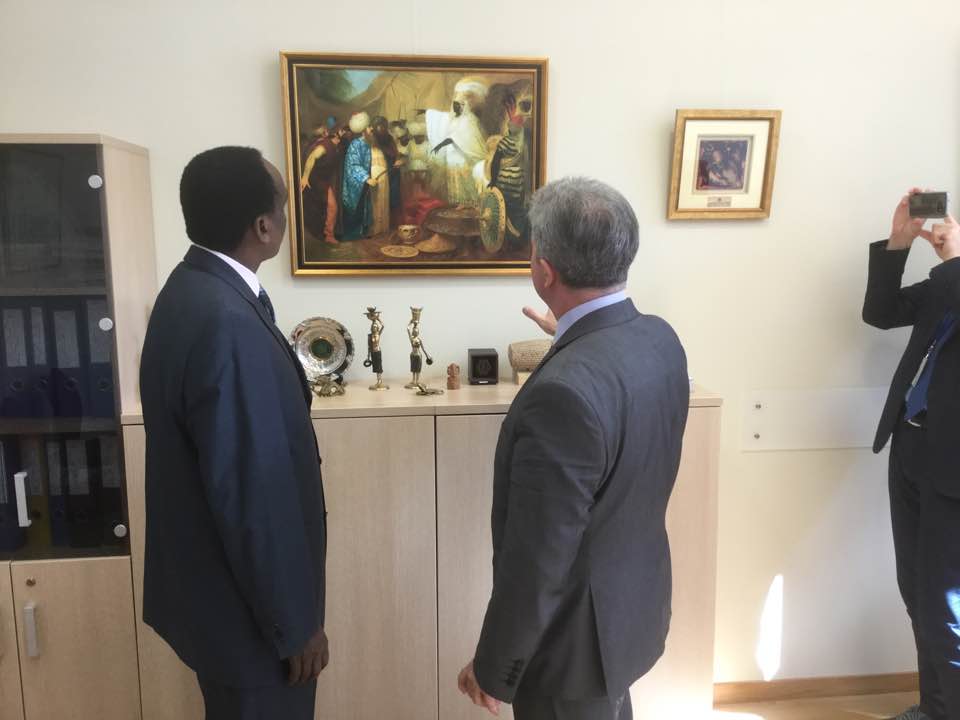
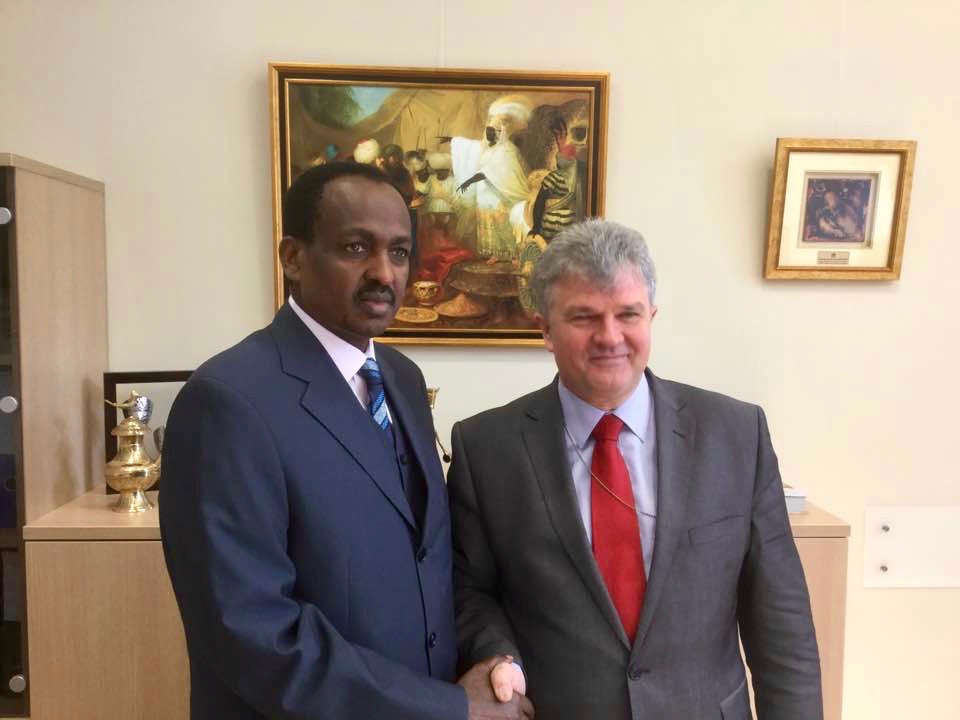
H.E. Ambassador Teshome Toga with Mr. Eduardas Borisovas, Director of Latin America, Africa, Asia and Pacific Department at the Lithuanian Ministry of Foreign Affairs.
H.E. Ambassador Teshome Togawith Mr. Eduardas Borisovas in front of the painting “Persian Messengers at the Ethiopian King”.

Read more about this painting: http://54.247.69.120/build/movio/movioTraining8/en/85/smuglevicius-p_-persian-messengers-at-the-ethiopian-king

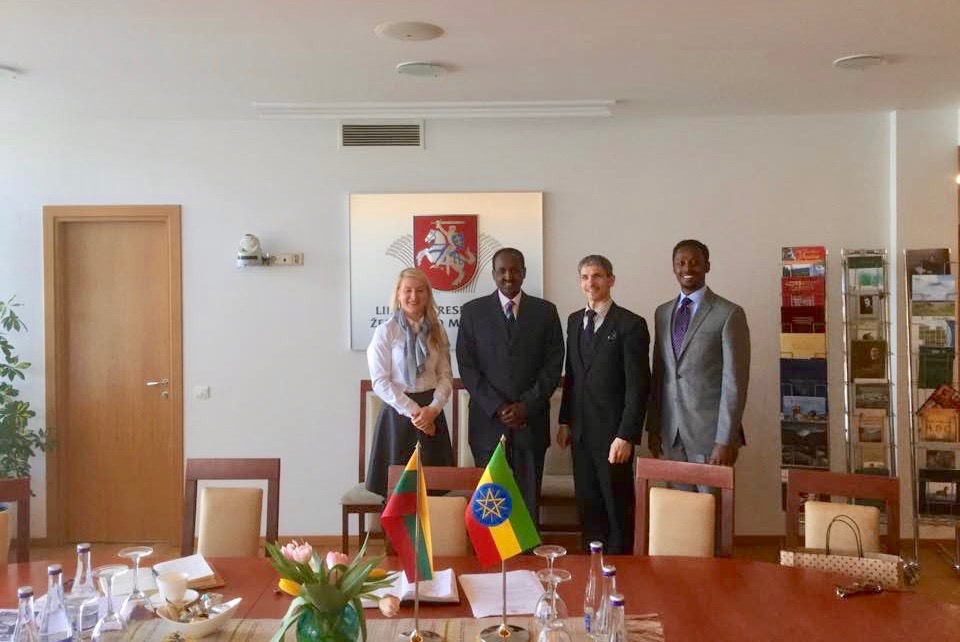
With officials of the Ministry of Agriculture of Lithuania
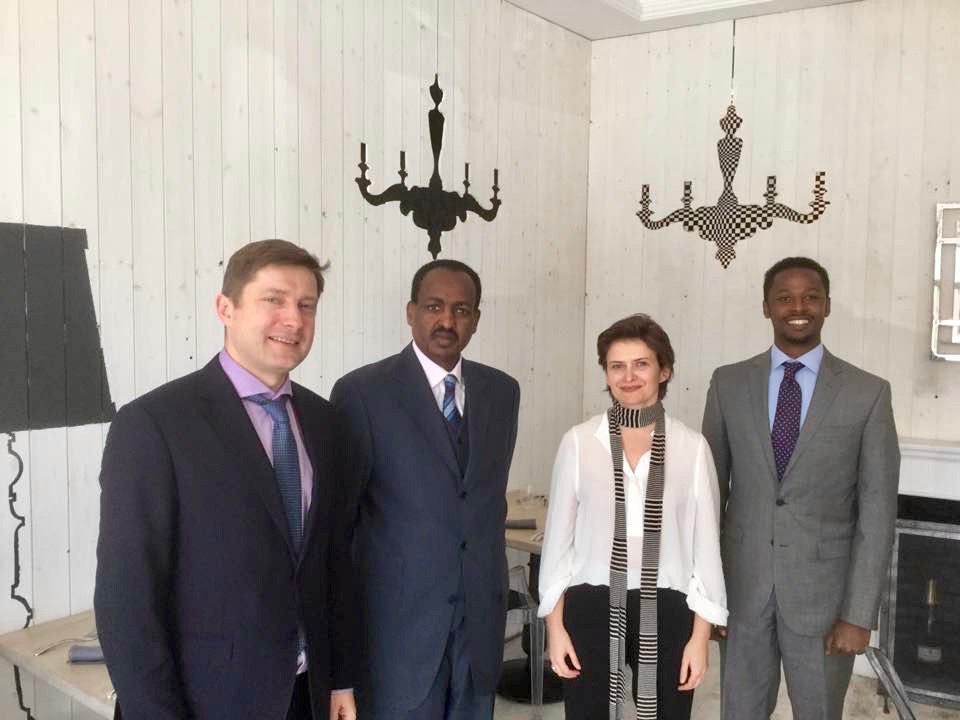
With NRD AS team
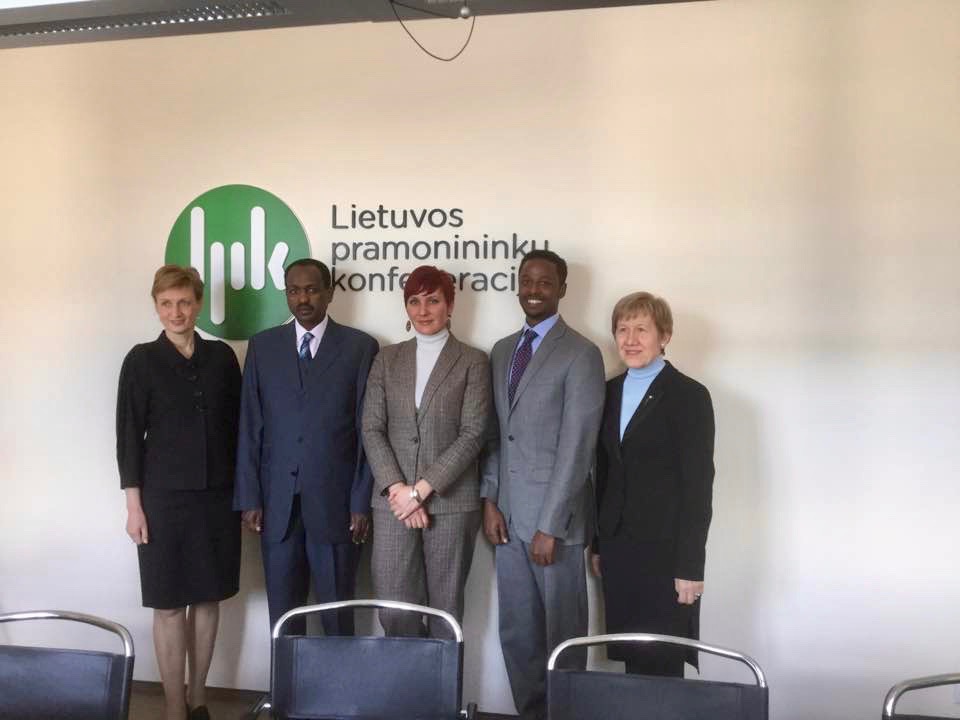
Confederation of Industrialists, Chamber of Commerce and Business Club team of Lithuania

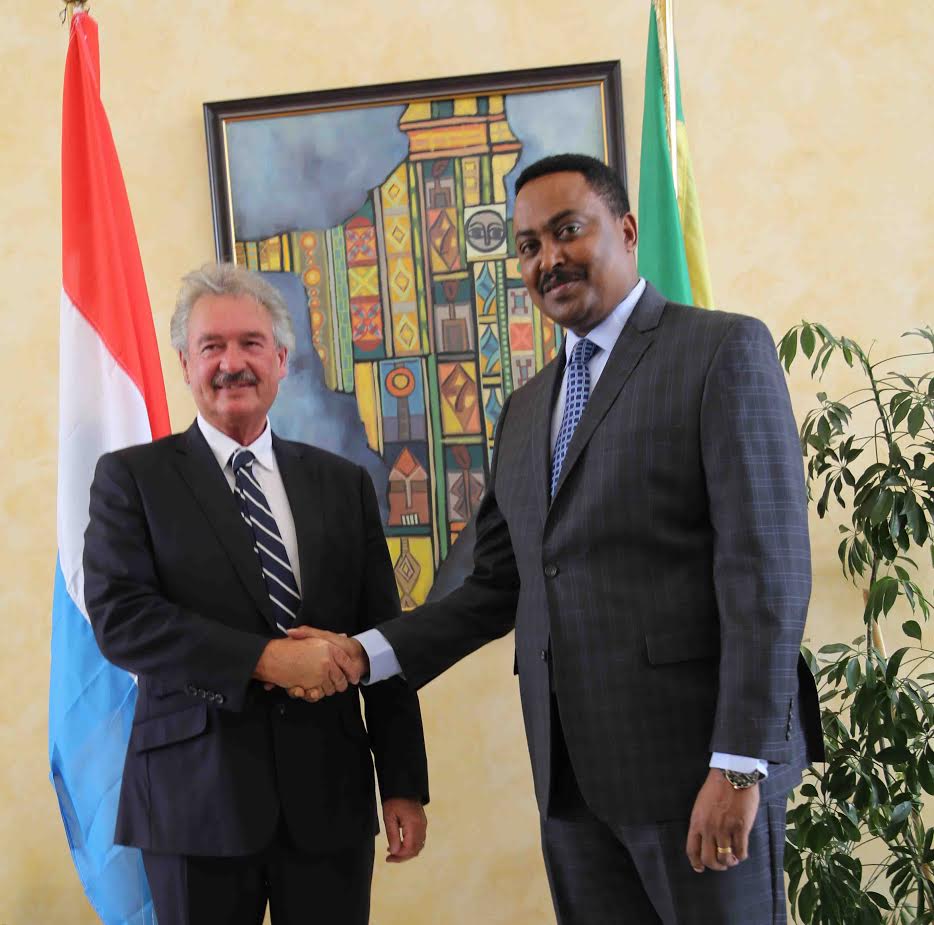
Dr. Workneh holds talks with Foreign Minister of Luxembourg

Foreign Minister Dr. Workneh Gebeyehu met with Jean Asselborn, Luxembourg’s Foreign Minister in Addis Ababa, today  (April 25, 2017) and discussed how the sustainable and sound relationship between Ethiopia and Luxembourg could further be nurtured.

Dr. Workneh noted the strategic engagement between Ethiopia and the European Union in general and the growing level of a broad spectrum of economic partnership between Ethiopia and Luxembourg in particular. “Our partnership with Luxembourg,” he added would surely offer a strategic importance to Ethiopia’s development agenda.

Taking note of the enormous market opportunity and the enabling trade and investment environment in Ethiopia, Minister Workneh reiterated the importance of deepening the economic cooperation between the two countries. In such light, he further noted that the two countries should work together to explore potential areas of cooperation and partnership.

Briefing the Luxembourg delegation on current situations in Ethiopia, the Minister said Ethiopia is now in a state of normalcy, adding that the government has been working to fully ensure the prevalence of peace and security in the country.

On issues of regional peace and stability, Dr. Workneh pointed out how Ethiopia is working both bilaterally and through the multi-lateral sub-regional organization, IGAD to ensure  peace and stability in the region.

Foreign Minister of Luxembourg, Jean Asselborn, described Ethiopia as an important developmental partner in Africa, and said Luxembourg companies are keen to involve and work as complementary business partners in the air transport service and other related sectors.

Apart from the transport sector, he also noted that Luxembourg is keen to further strength the bilateral economic cooperation in areas of service provision, and other industry sectors.

Foreign Minister, Dr. Workneh, welcomed the initiative and stressed that as Ethiopia is aggressively investing on infrastructural development all over the country, Luxembourg’s  involvement in Ethiopia’s transport sector will offer significant support.

Ethiopia remains committed to engage with Eritrea for lasting peace

The European Union High Representative and Vice-President of the European Commission, Ms. Federica Mogherini, said last week that the EU was ready to support the settlement of the border dispute between Ethiopia and Eritrea. In a press statement, issued on April 13, she said: “The EU encourages all concrete steps that could lead to finally demarcating the border in accordance with the EEBC decision and to move to a phase of building constructive and peaceful relations… the EU stands ready to support the process and any measures that will create conditions for a mutually beneficial relationship between Eritrea and Ethiopia in the future.”

Ethiopia welcomes this commitment of the European Union to support full implementation of the provisions of the Eritrea-Ethiopia Boundary Commission’s Decisions of April 13, 2002.  Ethiopia had repeatedly reiterated its readiness for peace and called time and again for dialogue to restore ties and normalize relations with Eritrea. The regime in Asmara has shown no sign of interest either in these efforts or in a number of initiatives by different countries and eminent personalities. All have, regrettably fallen on deaf ears.

Ethiopia, despite the serious flaws in the Eritrea-Ethiopia Boundary Commission’s Decisions, fully accepted the Decisions as final and binding. By contrast, Eritrea, after much interference in the activities of the UN Peacekeeping forces of the UN Mission in Ethiopia and Eritrea (UNMEE), finally restricted the Mission’s fuel supplies in January 2008, seized much of the Mission’s equipment and finally ordered the troops to leave Eritrea a month later. This erratic behavior in direct violation of the Algiers Agreement, rendering it null and void, was enough reason for Ethiopia to invoke the comprehensive peace agreement and binding arbitration that the two parties agreed to on June 18, 2000. However, Ethiopia determined to honor the commitment of the parties to the peace process, still appeals to the full implementation of the Algiers agreement. Ethiopia, the victim of Eritrean aggression in 1998 wants dialogue and engagement to implement the EEBC decision. This is the minimum the victim of aggression can expect; this is minimum the aggressor, Eritrea, should provide and without preconditions.

In fact, the need for dialogue is written into the Ethiopian-Eritrean Boundary Commission’s decisions. The Commission, for example, clearly indicated under Article 2.16 of its decision that “these coordinates are not necessarily final and the commission may have to adjust or vary them in the course of demarcation. Only the final demarcation map will be definitive”. This demonstrates clearly that the coordinates used for the “virtual demarcation” that the EEBC issued in November 2006, could not be final. Article 2.19 stated that “the tripoint at the eastern end has never been agreed” by the parties; Article 2.20 of the decision informed the international community that, the boundaries laid down in the Treaties (1900, 1902 and 1908 of the West, Central and Eastern borders respectively) had never been implemented by demarcation. These points alone underlined the necessity for dialogue on demarcation irrespective of the need for discussions on other issues. .

Article 16 of the Algiers Agreement between Ethiopia and Eritrea forecast that “Recognizing that the results of the delimitation and demarcation process are not yet known, the parties request the United Nations to facilitate resolution of problems which may arise due to the transfer of territorial control, including the consequences for individuals residing in previously disputed territory”. The border issues cannot, of course, be reduced to demarcation alone. Far more important is the question of long-lasting peace and stability among and between the peoples on both sides of the border. The anomalies and impracticalities of the virtual delimitation of the EEBC can only be resolved through dialogue. This is normal international practice. Others including Cameroon and Nigeria, and Russia and China, have shown that final border demarcation should come after normalization. This is a prerequisite for a sustainable relationship between Ethiopia and Eritrea, and for lasting peace in the region.

Ethiopia prepared all the legal and administrative procedures for the independence of Eritrea.  Ethiopia was the first country to recognize the legitimacy of the new State of Eritrea. It never had a plausible reason to get into a quarrel over a small piece of land in the border area. Ethiopia’s concerns have always been the lasting relationship between the two peoples. Ethiopia does not believe making the Eritrean people hostage in the name of ‘border conflict’ should be allowed to benefit the Eritrean Regime. The Eritrean Government’s continual refusal to come to the negotiating table and the resultant ‘no war no peace’ situation between the two countries, has created unbearable conditions for the Eritrean people. There are more than 170 thousand Eritreans sheltering in refugee camps in Ethiopia. Eritrea is ranked 3rd in the list of countries from which refugees enter Europe, after Syria and Afghanistan, both war-torn countries. Eritrea has no such excuse.

This situation has continued for far too long. Ethiopia appreciates the expressed support from the EU and other partners for normalization of its relations with Eritrea, but it feels that it is now high time to push the regime in Asmara to come to the negotiating table.

Asmara, while continuing to show no interest to making peace with its neighbors, has recently started to implement a two-pronged approach in its foreign policy: aiming to ease the sanctions’ regime and win international sympathy. It has been trying to convince the international community that it has changed its behavior and that it is being unfairly penalized by the UN Security Council and the major powers. It has argued that the sanctions are unfair particularly against a very poor and small country like Eritrea. This is intended to persuade the Security Council to moderate the sanctions without having to make any substantive move to address the concerns of the sub-region and the reasons for the imposition of sanctions in the first place. The semi-implementation of the sanctions couples with the severe economic situation in Eritrea, and perhaps reduced the capacity of the regime to destabilize the Horn Africa. It has not affected its intention to continue to do so.

Eritrea, in fact, has made no behavioral changes in its approach to its neighbors. The regime has continued to destabilize countries of the region, providing financial, military, intelligence and non- military assistance, including at various times the provision of training centers, camps and other similar facilities for armed groups such as Al-Shabaab and Arbegnoch Ginbot 7, as well as issuing travel documents, offering living expenses and travel facilities in a discrete manner. If a lasting peace and stability is to come about in the Horn of African, partner countries must push the regime in Asmara to show a real change, including the dismantling of training camps and ending financial and other logistical support. Eritrea must, in fact, refrain from destabilizing the region by supporting armed groups such as Al-Shabaab and Arbegnoch G7.

Last week, the UN Security Council discussed the Somalia Eritrea Sanctions Committee report. The Chair of the Security Council Committee, Kazakhstan, has presented its report covering the period from November 2016 to February 2017 to the Council.

Ambassador Kirat Umarov’s briefing focused on the activities of the Committee and on the assessment of recent developments based on the latest reports of the Somalia and Eritrea Monitoring Group. On Somalia, the chair underlined that AI-Shabaab remains the most significant threat to peace and security in Somalia while ISIL continues to maintain a presence in port town of Qandala mountainside. In light of the on-going drought, the chair noted that uncontrolled humanitarian assistance can result in additional threats to the peace, security and stability of Somalia. He told council members about the threat to peace and security posed by the illegal, unreported and unregulated fishing in the country.

Turning to Eritrea, the report indicated that the monitoring Group is conducting ongoing investigations on the support by Eritrea to armed groups in the region as well as on the potential breaches of the arms embargo. The chair also highlighted that the Somalia and Eritrea Monitoring Group (SEMG) continues to seek clarification on the whereabouts and the situation of the remaining combatants missing in action since the Djibouti/Eritrea border clashes of 2008.

Following the chair’s presentation, Council members discussed on the report, and in their remarks alluded Al-Shabaab as the biggest threat to peace and security in the region. While Council members took note of the SEMG’s report that there was no conclusive evidence of Eritrean support to Al-Shabaab in the last consecutive reports, they underlined the need for Eritrea to cooperate with the SEMG in such score, and urged the Government of Eritrea to comply with its international obligation, including compliance with the Chapter VII resolutions of the Security Council.

Noting that the report is useful and very well balanced and stressing the significance of the Somalia-Eritrea Sanctions regime for regional peace and security in the horn of Africa, Ambassador Tekeda emphasized on the importance of the full and effective implementation of the sanction. “It is in this context that we appreciate the Committee for holding the briefing session with representatives of IGAD on transnational terrorist threats in the region,” he added. As such briefings have a lot of relevance to the work of the Committee he encouraged the Chair of the Sanction Committee to continue this good practice, in line with its mandate, and create a better understanding of the challenges and threats facing the region.

Although Al-Shabab’s conventional capabilities have been significantly weakened, the Ambassador said the group remains to be a potent force capable of launching asymmetrical attacks. He also noted the possibility of the group to forge links with ISIL/Daesh and expressed his concern on the enormous implications it would pose on the peace and stability of the region. He said, this certainly entailed the need to establish a close follow up into its activities. Welcoming the appointment of the new members of the Monitoring Group, the Ambassador expressed Ethiopia’s readiness to cooperate with the Group, mindful of the importance of cooperation in the pursuit of gathering relevant and quality of information from countries of the region and beyond. He also reiterated the importance of the cooperation of both Somalia and Eritrea as well as countries of the region in facilitating the work of the Monitoring Group and indeed the Sanctions Committee.

“In light of reports of possible violations of the arms embargo, in particular,” Ambassador Tekeda added, “we will wait the Monitoring Group to inform us of the outcome of its investigation in its mid-term report.” In such light, he stressed on the importance of forging the necessary horizontal cooperation with other Panel of Experts in the process of investigating reports of possible violations.

While appreciating the willingness on the part of the Federal and regional governments in Somalia to cooperate with the Monitoring Group, Ambassador Tekeda urged the “Eritrean government to render the necessary cooperation to the Monitoring Group and the Sanctions Committee based on its obligations in line with the relevant Security Council resolutions.” In this regard, he noted the Monitoring Group’s call on Eritrea to clarify “the situation of the remaining soldiers identified by Djibouti as still missing in action as a result of the conflict in June 2008 in line with its treaty obligations and as directed by this Council.”

Ambassador Tekeda, took note of the intention of the Chair to undertake a visit to the region, adding that while this was long overdue it would certainly add up to a better appreciation of the regional dynamics. He expressed his hope that the visit would take place in accordance with existing practices and made it clear that “putting preconditions on the visit to enlist concessions from the Council should by no means be entertained as it sets a dangerous precedent.” He said, “Among other things, it would allow him to appreciate the existing hubris ad arrogance that has been so much a problem in our region, but behind a veneer of victimhood, which can deceive many. That is the context within which the issue of the boundary demarcation should be looked at since seen with other matters it very much pales by comparison, for limitation having been completed what remains is demarcation regarding which Ethiopia cannot be expected to clap with one hand.”

While expressing his confidence on the Chair, the Ambassador however said, “given the geopolitical situation in our region this matter as well as the issue of sanctions can easily be politicized.” He further said he would not feel that the link between Eritrea and Al-Shabaab has conclusively been proven to be non-existent, adding: “given the mortal danger, Al-Shabaab represents, this is not a joke; [and] it is a serious matter.”

Permanent Representative of Djibouti, Ambassador Mohamed Siad Doualeh, also shared the Chair’s assessment that Al-Shabab continues to pose a serious threat to the peace and security in Somalia, calling for the surge in troops as well as logistical support to “decisively degrade and defeat Al-Shabab.” Eritrea, he said, has deliberately continued to obstruct the work of the Monitoring Group, noting that: “Eritrea cynically seeks to be rewarded for its defiance of Security Council’s resolutions.” The Ambassador also told the Council that his country had already shared the SEMG, a credible and verifiable evidence, which he said showcased Eritrea’s continued support to Al-Shabab, and thus called on the Monitoring Group to make the necessary investigations. He also urged Eritrea to clarify the situation of the unaccounted thirteen remaining Djibouti Prisoners of War, and to implement, in good faith, the peace agreement mediated by Qatar. The Ambassador further said Eritrea has continued to harbor, train, equip and provide logistical support to armed groups seeking to overthrow and destabilize the Government of Djibouti, in violation of Article 2 of the UN Charter.

Source: A Week in the Horn
Ethiopia, Latvia agree to forge economic cooperation

Ethiopia and the Republic of Latvia have agreed to forge economic cooperation covering a wide range of sectors, including air transport service, educational partnership, forestry and climate change as well as information and communication technology.

This has been emphasized this morning (April 24, 2017) during a meeting between State Minister Mrs. Hirut Zemene and a Latvian delegation led by Andrejs Pildegoviês, State Secretary of the Republic of Latvia.

State Minister Hirut briefed the delegation on how Ethiopia’s economic policy and strategy have transformed the country’s economy over the last decade, while noting that Ethiopia is also working to become a middle income country by 2025.

She also briefed the delegation on the tremendous investment opportunities in Ethiopia and called on Latvian companies to do business and invest in Ethiopia. Noting that there are plenty of opportunities and potentials for cooperation, Mrs. Hirut particularly underlined that both countries should work closely to maximize the benefits of economic partnership.

State Secretary of the Republic of Latvia, Andrejs Pildegoviês expressed that his government is keen to expand its engagement with Ethiopia and forge economic cooperation.

The Latvian delegation, he said, had already begun to explore potential areas of doing business and investment in Ethiopia. To this effect, he added his team met with members of the Ethiopian Chamber of Commerce and Sectoral Association earlier today.

Mrs. Hirut commended the initiative, and as Ethiopia is one the few countries that have ambitious plans of building green economy, she said it would be very useful to share experiences in the area of forestry management and of climate change.

The two sides have also reiterated the need to work in concert on areas of regional and global security issues of common interest.

State Minister Hirut confers with Danish Minister for Immigration and Integration

State Minister Mrs. Hirut Zemene met with Danish Minister for Immigration and Integration, Ms. Inger Stojberg, on Thursday last week (April 20). Discussions covered ways of cooperation on migration and refugee management.

The State Minister briefed the Minister on Ethiopia’s efforts in hosting more than 800,000 refugees from neighboring countries, adding that Ethiopia’s open camp policy allowed refugees the possibility of easily integrating with the society, while also taking note that Ethiopia was a country of origin, transit and destination for migrants.

She underlined the importance of addressing the root causes of migration through creation of jobs and requested Denmark to focus on this issue, adding that Ethiopia welcomed EU’s approach of setting up some programs to help integrate refugees.

Ms. Inger Stojberg appreciated Ethiopia’s role in dealing with migration and Ethiopia’s hospitality in receiving refugees. The previous day the Minister paid a visit to Hitsats Camp and Endabaguna Reception Center in Tigray, organized by the UNHCR and the Administration for Refugee and Returnee Affairs. The Minister said that she had been impressed by what she had seen in the refugee camps that she has visited.

The 6th Tana High Level Forum on Security in Africa wraps up

The 6th Tana High Level Forum on Security in Africa wrapped up on Sunday (April 23, 2017), following dozens of panel discussions and public lectures on a range of themes, including natural resource governance and pressing security issues in Africa.

Prime Minister Hailemariam Dessalegn in his closing remarks described the Forum provided an informal platform to articulate African common interests. The premier recollecting Ethiopia’s long standing contribution to Pan Africanism and its ideals, emphasized that Tana High Level Forum on Security in Africa is only one aspect of Ethiopia’s commitment to African causes He added that Tana High Level Forum on Security in Africa which is promoted to Tana foundation last year will officially start its operation next month.

Former president of Nigeria and the Chairperson of Tana High Level Forum on Security in Africa, Olusegun Obasanjo appreciating the all rounded support Ethiopia has given to the Forum, expressed that the forum with an informal setting provides Africans from a range of strata with the freedom to put forward African “Solutions to African Problems,” particularly in the field of security. He said the platform because of its inclusivity helps not just bring about diverse opinions but also help do away with the ‘WE/THEY’ dichotomy in policy making and implementation.

‘‘We have done well but not enough, we would do better,” and Tana High level forum on security in Africa is one indispensable means to that end, he added.

Oromia, Somali states agree to peacefully solve border dispute

On 20 April 2017, the Oromia and Somali states of Ethiopia have signed an agreement to peacefully solve disputes that arose among communities of the two states and enforce the referendum made in over 400 Kebeles in 2005.

State Chief from the Ethiopian Somali region Abdi Mohammed and Oromia State Chief Lemma Megerssa signed an agreement to take administrative decisions for the 147 Kebeles found on the border between the two states.

The two states have agreed to bring the insurgents to justice who engage in bringing people of Oromia and Somali against each other, and vowed to solve any dispute that may arise in these areas.

The Minister for Federal and Pastoral Affairs, Kassa Tekleberhan, who presided over the signing ceremony, said that the agreement will give lasting solution for disputes. He also said that the government has made effort since 2013 to resolve the dispute by establishing an overseeing committee.

After signing the agreement, Oromia state chief Lemma Megersa said that the deal is “a big victory.” Somali State Chief Abdi Mohammed on his part said that there shall not be a conflict among the two friendly peoples anymore and said that they will work hard to help the two people benefit from peace and development in these areas.

Political parties ratify regulation for dialogue

The 17 political parties, including the ruling coalition EPRDF, have ratified a common regulation to continue the dialogue and have selected three negotiators to chair the dialogue in sustainable manner.

The parties also have recruited three people to be in charge of agenda setting and they also have reached on consensus on memoirs of the dialogues held so far.

The parties have recruited Asefa Habtewold from the All Ethiopian Unity Party as chairperson, Wasihun Tesfaye of Ethiopian Democratic Party as Immediate Deputy Chairperson, and Alemayehu Deneke of New Generation Party as Deputy Chairperson.

Asmelash Woldesillassie of EPRDF, and Gebru Berhe and Melaku Mesele from opposition parties taking part in the dialogue are recruited to act in charge of agendas setting for the looming dialogues.

The committee will collect the agendas for negotiation from every political party taking part in the negotiation within 15 days starting from the 20th of April 2017.

According to the regulation the parties approved on the 10th of April 2017 to govern the negotiations, decisions during the negotiations will only be passed through a sufficient consensus.

EPRDF, which had been leading the meeting for the last nine rounds, is now replaced by the three newly appointed moderators that are expected to summon all the political parties for the submission of their agenda.

The political parties dialogue which was initiated in January 2017 can be seen as one of the reform initiatives taken to respond the public demand for more political inclusiveness and that will further contribute to the democratization process of the country.

The Ethiopian Human Rights Commission presents finding of 2016 protests to the Parliament

On the 18th of April 2017, the Ethiopian Human Rights Commission (EHRC) unveiled the results of the investigation it carried out following the violence in some parts of Amhara, Oromia and SNNP regional states in 2016. The report was presented to the House of Peoples Representatives (HPR).

The EHRC said a total of 669 people were killed in the unrests, 495 people (465 civilians, 33 security personnel) in Oromia, 140 people (110 civilians and 30 security personnel) in Amhara and 34 people in the SSNP regional states.

The investigation was carried out in 15 zones and 91 towns of Oromia, 5 zones and 55 districts in Amhara as well as in six zones in SNNP regional states.

Dr Addisu Gebregziabher, Commissioner of EHRC, said problems of good governance, failure to implement the special interest of Oromia in Addis Ababa as per the Constitution and the Addis Ababa Master Plan were the main causes for unrest in Oromia regional state.

During the Irreecha festival on 2nd of October 2016, security forces did not use forces against the crowd except firing tear gas and this measure was proportionate, the report said. However, the commission also recommended security officers to be held accountable for failing to contain the violence in the same area the next day.

The Commission said the illegal demonstrations orchestrated by the Oromo Liberation Front (OLF), Oromo Federalist Congress (OFC) and Oromia Media Network caused ethnic-based attacks, ruined religious equality, violated the right to life and inflicted physical injuries on people.

The Commission further suggested the federal government and Oromia regional state to join hands in the fight against racial hatred, religious extremism and ethnic-based attacks.

Regarding the violence in Gedeo zone (SNNP regional state), the Commission mentioned bad governance as reasons for the problems.

Similarly, the main reasons for the violence in Amhara was the identity issue of Wolkait, complaints claiming that there is dominance of Tigreans and others stating that land from Amhara was given to Sudan.

While the Commission said that in most cases, measures taken by security officers were legal and proportionate, it also indicated that security officers used unnecessary force in several cases.

The EHRC recommended solutions in order to ensure good governance, create employment opportunities for young people, rehabilitate those affected by the unrest, avert ethnic-based attacks, bring responsible security forces to justice, respect and promote people’s rights and prevent movement of illegal weapons.